Pages

Tuesday, January 28, 2014

Massive dinosaur skeleton coming to Copenhagen

From The Copenhagen Post: http://cphpost.dk/news/massive-dinosaur-skeleton-coming-to-copenhagen.8060.html

A 17-metre diplodocus costing 4.3 million kroner will be the prize exhibit at the new Natural History Museum


Misty will tower over the museum's guests (Photo: Anders Drud, Statens Naturhistoriske MuseuDecember 10, 2013by Peter Stanners
A gigantic dinosaur named Misty is moving to Denmark after it was bought at a London auction two weeks by the Natural History Museum.
The complete 17-metre skeleton of a Diplodocus cost 4.3 million kroner and was secured through a grant from Det Obelsk Familiefond.
“We think it is important that Denmark’s Natural History Museum owns a dinosaur [...] so when we were suddenly given the opportunity to give the Natural History Museum this early Christmas present, we jumped at the chance,” fund chairman Christen Obel said in a press release. “Misty is an iconic and fascinating item and will surely create value for the museum for many generations.”

The Natural History Museum is run by the University of Copenhagen and Misty is expected to be exhibited in the new facilities that are planned near the Botanical Gardens in central Copenhagen.
By November the university had raised 650 million kroner of the 1.2 billion kroner the new facilities are expected to cost.

Misty's 17-metre-long skeleton is around ten times the height of an average person (Photo: Raimund Albersdoerfer)
University of Copenhagen rector Ralf Hemmingsen said that the dinosaur was a “steal”.
“Together with the museum’s unique collection of whales, Misty will be an icon in coming exhibits at the Botanical Gardens. But how or when depends on whether the financing for the planned museum is secured,” Hemmingsen said.
Accidental find
Misty was discovered in the US state of Wyoming in 2009 by the children of the German palaeontologist Raimond Albersdörfer.
Albersdörfer was in the midst of another dig and encouraged his sons to try their own luck in a nearby location.
They returned in the evening telling him that they had found a bone that was so large that they could not carry it. Albersdörfer immediately helped his kids uncover the amazing find.


Monday, January 27, 2014

Road Test: A walk among dinosaurs proves a legendary family day out

From South China Morning Post: http://www.scmp.com/lifestyle/family-education/article/1376856/road-test-walk-among-dinosaurs-proves-legendary-family

It was with some excitement that we set off bright and early one Sunday morning to join the queue outside the Hong Kong Science Museum.
A large number of families and groups were waiting for the doors to open so we could go "see the dinosaurs", as our two-year-old succinctly put it.
He seemed to think he was about to enter a real-life Jurassic Park, complete with petting zoo and perhaps the occasional baby dinosaur to feed.
To be fair, the giant robotic dinosaurs at the entrance to the Legends of the Giant Dinosaurs did little to dispel his misconception. Amazed at first by their sheer size and realistic look, our three children jumped as the models moved.
This exhibition did not disappoint. The first part was made up of moving models and the children's favourites were found here, including the infamous Tyrannosaurus rex.
The exhibit was interactive and partly hands-on. The children found out what a brachiosaurus stomach would have felt like, and touched fossilised Euoplocephalus dung.
This alone would definitely gain our eldest son some street cred in the school playground. As he said, it doesn't get much cooler than touching "dinosaur poo" that is millions of years old.
The mechanical exhibits were also entertaining. At one point, our five-year-old daughter chatted away to an Oviraptor in much the same way she talks to her soft toys.
Designed with children in mind, the information with each exhibit is concise and interesting. Our seven-year-old was able to pick up facts as he read his way through.
The second part of the exhibition displays what's left of the real thing - the fossils.
There were many displays recreated from bones found in China, including Lanzhousaurus magnidens, whose teeth were the largest among all of the herbivorous dinosaurs.
The towering skeletons were a wondrous sight. A favourite picture from the family's morning at the museum was of our three children cowering under the skull of a T. rex.
The exhibits are broken up with high-definition short movies, each less than five minutes long, shown on big screens that illustrate how the dinosaurs may have become extinct.
Although Sunday mornings are a busy time to visit, the crowds were manageable on the day we went. To enjoy more space, it would be worth trying to make the trip on a weekday.

Verdict: the biggest dinosaur exhibit ever in Hong Kong was entertaining, interactive and educational. It would be a great way to spend an hour or two with children of any age.
My family will visit again before the exhibit ends in April. In fact, we will probably try to head back several times. Legends of the Giant Dinosaurs, Hong Kong Science Museum, 2 Science Museum Rd, TST East, HK$10, HK$20; hk.science.museum/lgd


Friday, January 24, 2014

Roadside Dinosaur Parks

Huffington Post, Dec 6, 2013: http://www.huffingtonpost.com/atlas-obscura/roadside-dinosaur-parks_b_4267917.html
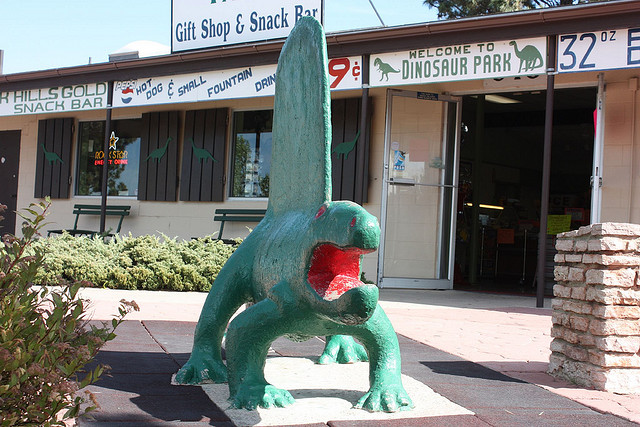
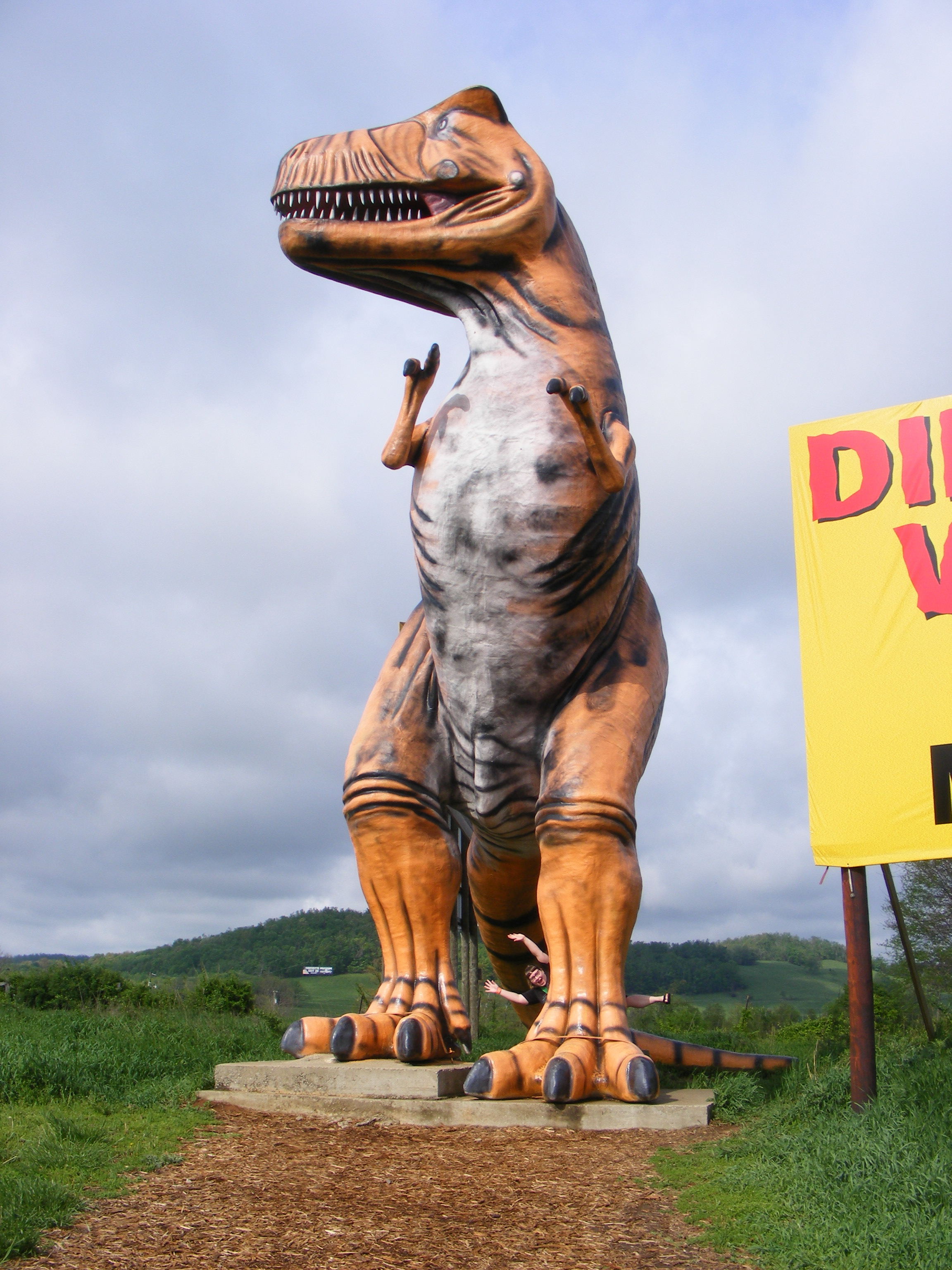
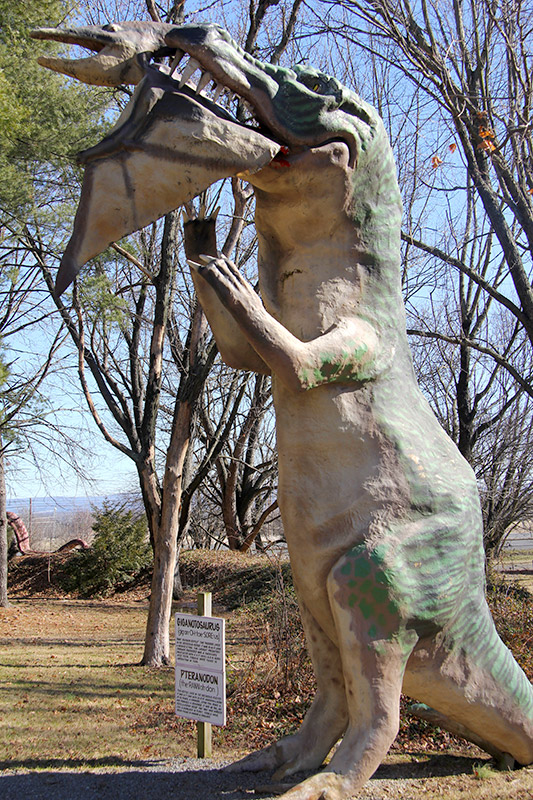
Kitschy dinosaur parks are about as abundant around the world as the thunder lizards themselves once were. Largely an American phenomenon, it seems as though there was a period of post-Depression boom times when any enterprising amateur with concrete, free time, and a child's guide to prehistory was building titanic menageries of "good enough for government work" creatures.
Not content to simply mangle the (to be fair, largely misunderstood at the time) anatomy of the saurian behemoths, most of these attractions also painted their beasts like technicolor nightmares. Whether its due to the wonders of prehistoric life or bad design, these creature collections remain a must-see stop on any road trip. Check out some of these mangy monsters that clearly spared every expense:
South Dakota's Depression-era Dinosaur Park still looks a little depressed. 2013-11-13-c671d7269f3926ab38c05e0d95d87facc6e60938.jpg
Image via Paul Weimer
A Tyrannosaur-ish Rex at Kentucky's Dinosaur World.
2013-11-13-c99095735f5547eacc75fcf4b3004214216323c6.jpg
Image via Atlas Obscura
Then there's this clever girl in Virginia's Dinosaurland.
2013-11-13-9ef033171c49cf7393_gigantosaurus_pteranodon.jpg
Image via Dinosaurland
To see more derpy dinos, check out Atlas Obscura's collection of dinosaur parks!
http://www.atlasobscura.com/categories/dinosaur-parks


Wednesday, January 22, 2014

Podcast of Wyoming dinosaur tracksite available

From Dec 4, 2013

View dinosaur tracksites by podcast courtesy of the Bureau of Land Management’s Worland Field Office.

The online podcast features the Red Gulch Dinosaur Tracksite about 10 miles east of Greybull and four miles west of Shell. It is the largest tracksite in Wyoming and one of the most extensively and intensively studied sites in the world, according to a release from the agency.

The podcast showcases the unique Middle Jurassic paleontological resources preserved at the site, which provide information about a population of meat-eating dinosaurs walking on an ancient tidal flat 167 million years ago. The podcast also highlights some of the state-of-the-art photogrammetric work done on dinosaur footprints in northern Wyoming.

View the podcast on YouTube by searching Red Gulch Dinosaur Tracksite. (The other link provided doesn't seem to be working....)

Tuesday, February 26, 2013

Never get involved in a land war in Asia

and never agree to transcribe 20 hours of meetings from an Australian business meeting. That's what I've been doing for the last 4 days...utter nightmare. Could NOT understand their accents. Making it worse were the bad audio levels and the fact that a lot of the people preesnt insisted on talking over each other from all around the room except in front of the microphone... I will never transcribe ANYTHING every again. Anyway, so sorry to be MIA from my blogs.

Sunday, February 17, 2013

Dinosaur show fuels learning, imagination

From SFO Star Advertiser: Dinosaur show fuels learning, imagination
SAN FRANCISCO » About dinosaurs, the old masters, they were never wrong, to paraphrase W.H. Auden if he were writing a poem about the endless fascination kids have with prehistoric beasts. That fascination is part of the reason "Dinosaur Train" is popular among the youngest members of the PBS audience and why the show's fans will enjoy the new special "Dinosaur Train: Submarine Adventure," airing Tuesday.
‘DINOSAUR TRAIN: SUBMARINE ADVENTURE’
The PBS special airs at 9 p.m. Tuesday. Repeats 1 p.m. Wednesday and 5 p.m. Thursday.


"Dinosaur Train," which premiered in 2009, "stars" Buddy, a curious young Tyrannosaurus Rex whose egg somehow winds up in a nest of Pteranodons (technically flying reptiles — not dinosaurs).
Buddy and his scaly buddies ride the Dinosaur Train around the prehistoric jungles, volcanoes and other settings, learning about species. At the end of each show, a live-action segment with paleontologist Scott D. Sampson helps young viewers learn about the species they have just met with big, unpronounceable names.
"Submarine Adventure" follows the format of the show, but the submarine, of course, gives the dinosaurs a chance to learn about undersea life, including Otto the Ophtalmosaurus — whose speaking voice is disconcertingly reminiscent of Arnold Schwarzenegger's — Shoshana Shonisaurus and Maisie Mosasaurus. By tapping into childhood fascination with dinosaurs, the series and the special teach kids not only about various prehistoric species, but, in a more subtle way, about the diversity of life in the world. Buddy is a welcome member of a blended family.


Friday, February 8, 2013

Fresh Clues In Dinosaur Whodunit Point To Asteroid

From NPR: Fresh Clues In Dinosaur Whodunit Point To Asteroid

Some 66 million years ago, about 75 percent of species on Earth disappeared. It wasn't just dinosaurs but most large mammals, fish, birds and plankton. Scientists have known this for a long time just from looking at the fossil record. If you dig deep enough, you find lots of dinosaur bones. And then a few layers up, they're gone.
But scientists couldn't figure out exactly what had caused this phenomenon. Of course, there were lots of theories.
"Some of them are pretty wacky," says J. David Archibald, an evolutionary biologist at San Diego State University who wrote the book Dinosaur Extinction and the End of an Era. "The really weird ones, of course, are that space hunters came and killed them all off, they died of constipation, mammals ate their eggs."
Then, in 1980, a new theory surfaced.
"It's the one that everybody hears about all the time because it's most dramatic," Archibald says.
Near what is now the town of Chicxulub in the Yucatan Peninsula, an asteroid more than 5 miles across slammed into the Earth. It caused tsunamis and earthquakes, and threw up a cloud of dust that smothered the world.
It sounds like a movie premise, but the Chicxulub impact left behind evidence. It threw up small blobs of black glass that were later found in Haiti. It dusted the world with iridium, an element that is rare on Earth but common in meterorites. It left a barely detectable imprint on the Yucatan Peninsula. Many scientists came to believe that the Chicxulub asteroid alone killed off the dinosaurs — and the public ate it up.
"We have this thing for big glitz and dramatic things," Archibald says. "Instantaneous is better."
But Princeton professor Gerta Keller wasn't convinced. She has her own theories about the mass extinction.
"Vulcanism has played a major role," Keller says.
In the hundreds of thousands of years before the Chicxulub impact, volcanoes in a region of India known as the Deccan Traps erupted repeatedly. They spewed sulfur and carbon dioxide, poisoning the atmosphere and destabilizing ecosystems. Keller says the dinosaurs were already on death's door by the time the asteroid hit.
And there is confusion about when that actually happened.
"If [the impact] is the cause, it had to be precisely at the time of the mass extinction," Keller says. "It can't be before and it can't be afterwards."
Keller's data suggest that the impact happened about 100,000 years before the mass extinction. Previous studies, on the other hand, put it 180,000 years after the dinosaurs died off.
Enter Paul Renne, a geologist from the University of California, Berkeley. To pin down the date, he headed out to the badlands of northeastern Montana.
"It's a region that has yielded a huge number of dinosaur fossils over the years," Renne says. "It's very famous for that."
Renne collected samples of ash that were deposited at the time of the mass extinction just above that treasure trove of fossils. He also obtained some of the glass blobs left by the Chicxulub impact. Measuring the rate of decay of radioactive potassium from these two samples, Renne was able to estimate the age of the impact and the age of the extinction.
"And lo and behold they are exactly the same," Renne says. "The impact clearly occurred right at the extinction level."
His results are published in the journal Science. They reinforce an idea that many scientists have held for years: The Chicxulub asteroid was the straw that broke the dinosaurs' back.
Gerta Keller thinks Renne's method was admirably precise, but she doesn't agree with some of his conclusions. She says his data are contradicted by other samples from Texas where a similar age date shows the Chicxulub impact predates the KT boundary — the point in time between the Cretaceous and Tertiary periods when the dinosaurs are believed to have gone extinct.
Still, there is one thing that Keller and Renne agree on: The asteroid isn't the whole story.
"There were significant extinctions and ecological perturbations going on a million or 2 million years before the impact, so we think that something else was already happening," Renne says. "What caused those things? There is an outstanding candidate — the early eruptions of the Deccan Traps."
The next step will be to find the age of these eruptions.
"We need to be able to place that set of eruptions into a time framework," Renne says.
Then they can better piece together what happened to the dinosaurs — and the rest of the species that went extinct. Renne and Keller will join Archibald and dozens of their colleagues at the Natural History Museum in London at the end of March to talk over their ideas.
"I'm looking forward to rather spirited discussions," Keller says.