
Saturday, July 12, 2014
Summer posting schedule

Tuesday, May 20, 2014
The argentinosaurus

Discovery
The first fossils identified as Argentinosaurus were found in 1987 by a rancher in Argentina, who mistook the leg for a giant piece of petrified wood. A gigantic backbone was also found, and was almost as high as a man.The type species of Argentinosaurus, A. huinculensis, was described and published in 1993 by the Argentinian palaeontologists José F. Bonaparte and Rodolfo Coria. Its more specific time-frame within the Cretaceous is the late Cenomanian faunal stage, ~96 to 94 million years ago. The fossil discovery site is in the Huincul Formation of the Río Limay Subgroup in Neuquén Province, Argentina (the Huincul Formation was a member of the Río Limay Formation according to the naming of the time.)
Saturday, May 17, 2014
Fossilized bones of huge 100 TON dinosaur found
Move over T-rex, see you later Stegosaurus, adios Argentinosaurus. Scientists have announced that the bones of a new, even larger dinosaur have been found.
Argentinosaurus currently holds the record for being both the heaviest land animal ever, and the longest, but the fossilized bones of the biggest dinosaur ever discovered have been found in Argentina.
Scientists believe the species of titanosaur weighed in at 170,000 pounds, as heavy as 14 African elephants.
A local farm worker found the remains which were captured by the BBC's Natural History unit.
Scroll down for video


The fossils were then excavated by a team of palaeontologists from the Museum of Palaeontology Egidio Feruglio, led by Dr Jose Luis Carballido and Dr Diego Pol.

They unearthed the partial skeletons of seven individuals - about 150 bones in total - all in 'remarkable condition'.
According to the measurements of its gigantic thigh bones, the herbivore would have been 40m (130ft) long and 20m (65ft) tall.
Palaeontologists think it is a new species of titanosaur – part of a diverse group of sauropod dinosaurs that were characterised by their long necks and tails and small heads – dating from the Cretaceous period.
The mega dino would have weighed in at 77 tons, making it seven tons heavier than the previous record holder Argentinosaurus.
The creature, which lived in the forests of Patagonia between 95 and 100 million years ago, was yet to be named.
“It will be named describing its magnificence and in honour to both the region and the farm owners who alerted us about the discovery,” the researchers said.


That plant-eating dinosaur weighed a earth-shaking 90 tons when it lived about 90 million years ago in Argentina, although the record has been broken by this new find.
Oxford University palaeontologist Dr Roger Benson, who led the study, says the dinosaur weigh-in included species ranging from small bird-like dinosaurs to well-known carnivores such as the Tyrannosaurus rex.
The Tyrannosaurus rex, which weighed 7 tons, was the largest meat-eating dinosaur in the study, but it is small in comparison to the Argentinosaurus.


A sparrow-sized bird called Qiliania, which lived about 120 million years ago in China, earned the distinction of being the smallest dinosaur, weighing a mere 15 grams.
Dr Benson said Argentinosaurus, which roamed around South America, was about 6 million times the weight of Qiliania and that both still fit within the dinosaur family. 'That seems amazing to me,' he said.
The largest meat-eating dinosaur was Tyrannosaurus rex, which weighed 7 tons and is also the largest known land predator of all time.
Tuesday, January 28, 2014
Massive dinosaur skeleton coming to Copenhagen
A 17-metre diplodocus costing 4.3 million kroner will be the prize exhibit at the new Natural History Museum

“We think it is important that Denmark’s Natural History Museum owns a dinosaur [...] so when we were suddenly given the opportunity to give the Natural History Museum this early Christmas present, we jumped at the chance,” fund chairman Christen Obel said in a press release. “Misty is an iconic and fascinating item and will surely create value for the museum for many generations.”
The Natural History Museum is run by the University of Copenhagen and Misty is expected to be exhibited in the new facilities that are planned near the Botanical Gardens in central Copenhagen.
By November the university had raised 650 million kroner of the 1.2 billion kroner the new facilities are expected to cost.
 Misty's 17-metre-long skeleton is around ten times the height of an average person (Photo: Raimund Albersdoerfer)
“Together with the museum’s unique collection of whales, Misty will be an icon in coming exhibits at the Botanical Gardens. But how or when depends on whether the financing for the planned museum is secured,” Hemmingsen said.
Accidental find
Misty was discovered in the US state of Wyoming in 2009 by the children of the German palaeontologist Raimond Albersdörfer.
Albersdörfer was in the midst of another dig and encouraged his sons to try their own luck in a nearby location.
They returned in the evening telling him that they had found a bone that was so large that they could not carry it. Albersdörfer immediately helped his kids uncover the amazing find.
Monday, January 27, 2014
Road Test: A walk among dinosaurs proves a legendary family day out

A large number of families and groups were waiting for the doors to open so we could go "see the dinosaurs", as our two-year-old succinctly put it.
He seemed to think he was about to enter a real-life Jurassic Park, complete with petting zoo and perhaps the occasional baby dinosaur to feed.
To be fair, the giant robotic dinosaurs at the entrance to the Legends of the Giant Dinosaurs did little to dispel his misconception. Amazed at first by their sheer size and realistic look, our three children jumped as the models moved.
This exhibition did not disappoint. The first part was made up of moving models and the children's favourites were found here, including the infamous Tyrannosaurus rex.
The exhibit was interactive and partly hands-on. The children found out what a brachiosaurus stomach would have felt like, and touched fossilised Euoplocephalus dung.
This alone would definitely gain our eldest son some street cred in the school playground. As he said, it doesn't get much cooler than touching "dinosaur poo" that is millions of years old.
The mechanical exhibits were also entertaining. At one point, our five-year-old daughter chatted away to an Oviraptor in much the same way she talks to her soft toys.
Designed with children in mind, the information with each exhibit is concise and interesting. Our seven-year-old was able to pick up facts as he read his way through.
The second part of the exhibition displays what's left of the real thing - the fossils.
There were many displays recreated from bones found in China, including Lanzhousaurus magnidens, whose teeth were the largest among all of the herbivorous dinosaurs.
The towering skeletons were a wondrous sight. A favourite picture from the family's morning at the museum was of our three children cowering under the skull of a T. rex.
The exhibits are broken up with high-definition short movies, each less than five minutes long, shown on big screens that illustrate how the dinosaurs may have become extinct.
Although Sunday mornings are a busy time to visit, the crowds were manageable on the day we went. To enjoy more space, it would be worth trying to make the trip on a weekday.
Verdict: the biggest dinosaur exhibit ever in Hong Kong was entertaining, interactive and educational. It would be a great way to spend an hour or two with children of any age.
My family will visit again before the exhibit ends in April. In fact, we will probably try to head back several times. Legends of the Giant Dinosaurs, Hong Kong Science Museum, 2 Science Museum Rd, TST East, HK$10, HK$20; hk.science.museum/lgd
Friday, January 24, 2014
Roadside Dinosaur Parks
Kitschy dinosaur parks are about as abundant around the world as the thunder lizards themselves once were. Largely an American phenomenon, it seems as though there was a period of post-Depression boom times when any enterprising amateur with concrete, free time, and a child's guide to prehistory was building titanic menageries of "good enough for government work" creatures.
Not content to simply mangle the (to be fair, largely misunderstood at the time) anatomy of the saurian behemoths, most of these attractions also painted their beasts like technicolor nightmares. Whether its due to the wonders of prehistoric life or bad design, these creature collections remain a must-see stop on any road trip. Check out some of these mangy monsters that clearly spared every expense:
Image via Paul Weimer
A Tyrannosaur-ish Rex at Kentucky's Dinosaur World.
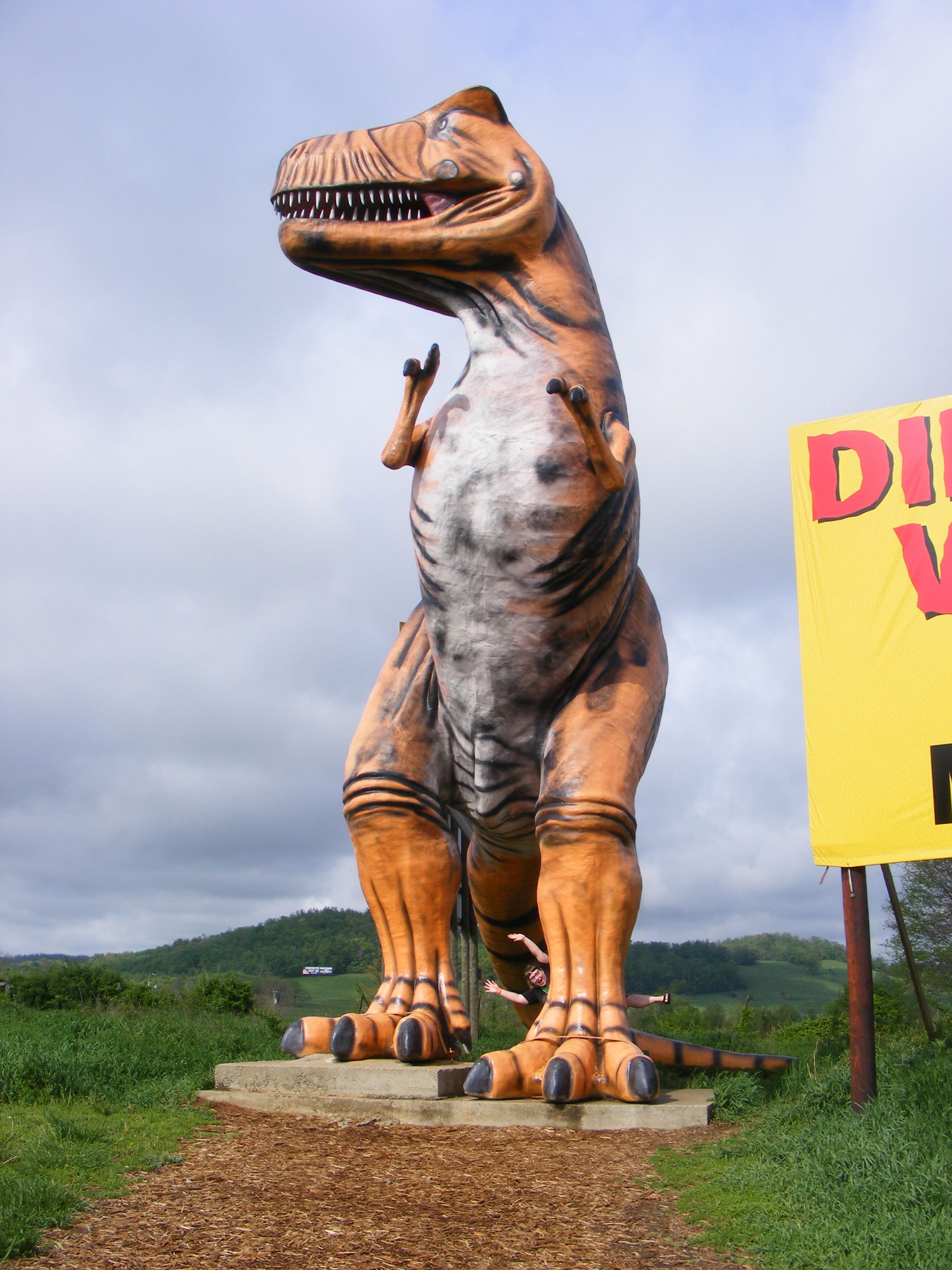
Image via Atlas Obscura
Then there's this clever girl in Virginia's Dinosaurland.
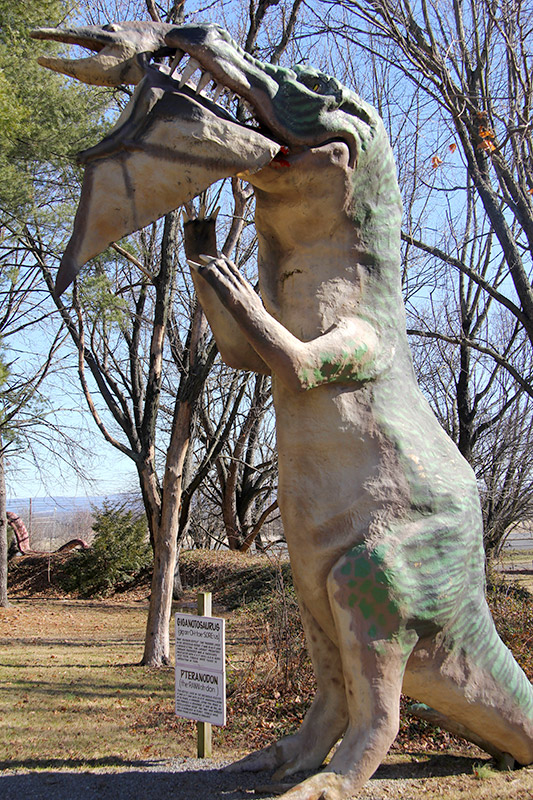
Image via Dinosaurland
http://www.atlasobscura.com/categories/dinosaur-parks
Wednesday, January 22, 2014
Podcast of Wyoming dinosaur tracksite available
View dinosaur tracksites by podcast courtesy of the Bureau of Land Management’s Worland Field Office.
The online podcast features the Red Gulch Dinosaur Tracksite about 10 miles east of Greybull and four miles west of Shell. It is the largest tracksite in Wyoming and one of the most extensively and intensively studied sites in the world, according to a release from the agency.
The podcast showcases the unique Middle Jurassic paleontological resources preserved at the site, which provide information about a population of meat-eating dinosaurs walking on an ancient tidal flat 167 million years ago. The podcast also highlights some of the state-of-the-art photogrammetric work done on dinosaur footprints in northern Wyoming.
View the podcast on YouTube by searching Red Gulch Dinosaur Tracksite. (The other link provided doesn't seem to be working....)
Tuesday, February 26, 2013
Never get involved in a land war in Asia
Sunday, February 17, 2013
Dinosaur show fuels learning, imagination
| ‘DINOSAUR TRAIN: SUBMARINE ADVENTURE’
The PBS special airs at 9 p.m. Tuesday. Repeats 1 p.m. Wednesday and 5 p.m. Thursday.
|
Friday, February 8, 2013
Fresh Clues In Dinosaur Whodunit Point To Asteroid
Some 66 million years ago, about 75 percent of species on Earth disappeared. It wasn't just dinosaurs but most large mammals, fish, birds and plankton. Scientists have known this for a long time just from looking at the fossil record. If you dig deep enough, you find lots of dinosaur bones. And then a few layers up, they're gone.
But scientists couldn't figure out exactly what had caused this phenomenon. Of course, there were lots of theories.
"Some of them are pretty wacky," says J. David Archibald, an evolutionary biologist at San Diego State University who wrote the book Dinosaur Extinction and the End of an Era. "The really weird ones, of course, are that space hunters came and killed them all off, they died of constipation, mammals ate their eggs."
Then, in 1980, a new theory surfaced.
"It's the one that everybody hears about all the time because it's most dramatic," Archibald says.
Near what is now the town of Chicxulub in the Yucatan Peninsula, an asteroid more than 5 miles across slammed into the Earth. It caused tsunamis and earthquakes, and threw up a cloud of dust that smothered the world.
It sounds like a movie premise, but the Chicxulub impact left behind evidence. It threw up small blobs of black glass that were later found in Haiti. It dusted the world with iridium, an element that is rare on Earth but common in meterorites. It left a barely detectable imprint on the Yucatan Peninsula. Many scientists came to believe that the Chicxulub asteroid alone killed off the dinosaurs — and the public ate it up.
"We have this thing for big glitz and dramatic things," Archibald says. "Instantaneous is better."
But Princeton professor Gerta Keller wasn't convinced. She has her own theories about the mass extinction.
"Vulcanism has played a major role," Keller says.
In the hundreds of thousands of years before the Chicxulub impact, volcanoes in a region of India known as the Deccan Traps erupted repeatedly. They spewed sulfur and carbon dioxide, poisoning the atmosphere and destabilizing ecosystems. Keller says the dinosaurs were already on death's door by the time the asteroid hit.
And there is confusion about when that actually happened.
"If [the impact] is the cause, it had to be precisely at the time of the mass extinction," Keller says. "It can't be before and it can't be afterwards."
Enter Paul Renne, a geologist from the University of California, Berkeley. To pin down the date, he headed out to the badlands of northeastern Montana.
"It's a region that has yielded a huge number of dinosaur fossils over the years," Renne says. "It's very famous for that."
Renne collected samples of ash that were deposited at the time of the mass extinction just above that treasure trove of fossils. He also obtained some of the glass blobs left by the Chicxulub impact. Measuring the rate of decay of radioactive potassium from these two samples, Renne was able to estimate the age of the impact and the age of the extinction.
"And lo and behold they are exactly the same," Renne says. "The impact clearly occurred right at the extinction level."
His results are published in the journal Science. They reinforce an idea that many scientists have held for years: The Chicxulub asteroid was the straw that broke the dinosaurs' back.
Gerta Keller thinks Renne's method was admirably precise, but she doesn't agree with some of his conclusions. She says his data are contradicted by other samples from Texas where a similar age date shows the Chicxulub impact predates the KT boundary — the point in time between the Cretaceous and Tertiary periods when the dinosaurs are believed to have gone extinct.
Still, there is one thing that Keller and Renne agree on: The asteroid isn't the whole story.
"There were significant extinctions and ecological perturbations going on a million or 2 million years before the impact, so we think that something else was already happening," Renne says. "What caused those things? There is an outstanding candidate — the early eruptions of the Deccan Traps."
The next step will be to find the age of these eruptions.
"We need to be able to place that set of eruptions into a time framework," Renne says.
Then they can better piece together what happened to the dinosaurs — and the rest of the species that went extinct. Renne and Keller will join Archibald and dozens of their colleagues at the Natural History Museum in London at the end of March to talk over their ideas.
"I'm looking forward to rather spirited discussions," Keller says.
Wednesday, February 6, 2013
Fossil of new flying reptile from dinosaur age discovered
Pterosaurs lived among the dinosaurs and became extinct about the same time, but they were not dinosaurs. They are sometimes wrongly called pterodactyls, which actually just describes the first genus of pterosaur discovered by scientists in the 18th century. Small pterosaurs developed during the Triassic Period, about 230 to 200 million years ago. Later, during the Jurassic and Cretaceous periods, more advanced forms of the flying reptiles, like azhdarchids, started evolving.
"These were long-necked, long-beaked pterosaurs whose wings were strongly adapted for a soaring lifestyle," researcher Darren Naish, a paleontologist from the U.K.'s University of Southampton, said in a statement. "Several features of their wing and hind limb bones show that they could fold their wings up and walk on all fours when needed."
The wingspan of Eurazhdarchoindicates it would have been "large, but not gigantic" compared to some of its cousins, Naish said. (The researchers pointed to the example of the giant azhdarchid, Hatzegopteryx thambema, whose bones found in the Romanian town of Hateg show that its wings would have stretched out 36 feet, or 11 meters, during flight.) The discovery brings new evidence to the debate about how azhdarchids lived, the scientists say.
"It has been suggested that they grabbed prey from the water while in flight, that they patrolled wetlands and hunted in a heron or stork-like fashion, or that they were like gigantic sandpipers, hunting by pushing their long bills into mud," Gareth Dyke, a paleontologist from the National Oceanography Center Southampton, said in a statement.
The newly found fossil was uncovered alongside dinosaurs and other terrestrial animals, suggesting that azhdarchids stalked small animal prey in woodlands, plains and scrublands rather than in coastal habitats.
"Eurazhdarcho supports this view of azhdarchids, since these fossils come from an inland, continental environment where there were forests and plains as well as large, meandering rivers and swampy regions," Dyke said.
The findings were detailed online Jan. 30 in the journal PLOS ONE.
Tuesday, January 29, 2013
Tiny Feathered Dinosaur Found

Remains of the tiny beast, dubbed Eosinopteryx brevipenna, found in northeastern China suggest it was slightly less than a foot long (30 centimeters) and had a short snout and a short tail. Based on the dinosaur's small wingspan and bone structure, researchers believe it would have been able to run around quite easily, but likely couldn't whip up enough of a wing-beat to fly. The dinosaur also sported toes that would have been suitable for walking along the ground, the researchers added.
This birdlike dinosaur's plumage was much more reduced compared with the feathers on some of its contemporaries, which suggests that feathering was already diversified by the Late Jurassic, adapted to different ecological niches and purposes, the researchers said. (The Jurassic period lasted from about 199.6 million to 145.5 million years ago.)
"This discovery sheds further doubt on the theory that the famous fossil Archaeopteryx — or 'first bird' as it is sometimes referred to — was pivotal in the evolution of modern birds," researcher Gareth Dyke, a senior lecturer in paleontology at the U.K.'s University of Southampton, said in a statement.
"Our findings suggest that the origin of flight was much more complex than previously thought."
Archaeopteryx was long thought by many to have been the earliest bird. Discovered in 1860 in Germany, it is sometimes referred to as Urvogel, the German word for "original bird" or "first bird." But recent findings suggest late-stage Jurassic Archaeopteryx was actually just a relative of the lineage that ultimately gave rise to birds.
The new research was detailed in the Jan. 22 issue of the journal Nature Communications.
Thursday, January 24, 2013
Secret of the Dinosaur Sexes Locked in Bone
Like other dinosaurs, T. rex had a row of spike-like bones called chevrons that ran from the base of the tail to almost the tip. Living alligators and crocodiles share this feature, and, decades ago, paleontologist Alfred Sherwood Romer suggested that researchers could distinguish between the skeletons of male and female crocodylians by looking at the placement of the first chevron in the series. In females, the chevron was thought to be shorter and displaced further back from the hips, leaving more room for eggs to pass through her body. Peter Larson, part of the team that excavated Sue but lost her in the prolonged legal battle that followed, extended the same argument to Sue. Since the tyrannosaur’s first chevron was situated further back than in other specimens, Larson proposed, the big T. rex was a female.
When the museum unpacked and reconstructed Sue, though, Sue’s sex came under suspicion. The “missing” chevron was found among the dinosaur’s assorted bones, undermining Larson’s contention. And, as it turned out, the entire comparison was flawed. In a 2005 study of crocodylian chevrons, Gregory Erickson, Kristopher Lappin, and Larson concluded that there is no sexual difference between the first chevrons of male and female crocodylians, nor any detectable dimorphism in tyrannosaurs. At best, the researchers concluded, the “usefulness of chevron anatomy for sexing dinosaurs is tenuous.”
We really don’t know whether Sue was a male or female. The entire episode was just one debate within the long-running attempts of paleontologists to investigate the basic, yet extremely frustrating question of how to properly identify dinosaur sexes. Skeletal differences alone are of almost no help. Every proposed case of sexual dimorphism in non-avian dinosaurs has either been undermined by later studies or is extremely questionable. Either non-avian dinosaurs didn’t show sexual dimorphism in their skeletons, or we have yet to properly detect the differences.
But there actually is a way to identify some female dinosaurs. Medullary bone gives them away. This specific bone tissue was deposited in the long bones of pregnant female dinosaurs, just as it is in living birds. Not all female dinosaurs were developing medullary bone when they died, but the gravid ones were.
Medullary bone can do more than help paleontologists pick out a few females, though. Paleontologists Andrew Lee and Sarah Werning paired the tissue with other histological clues to figure out that most dinosaurs started reproducing while they were still growing, long before they reached skeletal maturity. Dinosaurs lived fast and died young.
Such studies made me wonder if medullary bone could help paleontologists finally detect sexual dimorphism among non-avian dinosaurs. By picking a highly-ornamented species and searching for traces of medullary bone within those dinosaurs, researchers would be able to see whether the females all shared any distinctive anatomical structures or looked just like the males. The process wouldn’t identify all the females, but, if the attempt identified any at all, the investigation might help researchers determine whether there was any conspicuous features to distinguish the sexes.

The avian is a perfect candidate for such a study. Many of these birds are preserved with intact feathers, and their plumage comes in two forms. Some Confuciusornis are preserved with two elongated tail feathers, while others are not. Researchers have debated whether these ornaments are indicators of sexual dimorphism, species differences, individual variation, or simply different molt stages, but bone histology has finally solved the mystery. The Confuciusornis with the long feathers were males, while females lacked the flashy adornments.
A particular Confuciusornis known as DNHM-D1874 yielded the crucial clue. Surrounded by feathers, this articulated skeleton lacked the long tail feathers seen on others. When Chinsamy and colleagues looked at the microstructure of specific bones, they found medullary tissue in the humerus (upper arm bone) and traces in the ulna (a lower arm bone), indicating that the bird had recently finished laying eggs when she perished.
The researchers also sampled the bones of three Confuciusornis preserved with long tail feathers. These specimens didn’t contain medullary bone. While it’s possible that these were females that were not laying eggs around the time of death, the presence of medullary bone in the non-ornamented form and its absence in the ornamented ones is consistent with the idea that the feathers underscore a real sex difference. And since relatively small Confuciusornis have been found with long tail feathers, Chinsamy and coauthors point out, these birds probably started reproducing relatively early in life.
Paleontologists can apply the same technique to non-avian dinosaurs. There are multiple specimens of dinosaurs such as Microraptor and Anchiornis that are preserved with feathers, and the fact that we can detect the color of dinosaur feathers has opened yet another avenue for comparison. Perhaps male and female dinosaurs sported different colors, much like many bird species today. Feathers aren’t a requirement for this kind of study, though – the same technique could conceivably be applied to other non-avian dinosaurs so long as they are known from large enough sample sizes. By breaking into bone, paleontologists may finally be able to discover the secrets of the dinosaur sexes.
References:
Chinsamy, A., Chiappe, L., Marugán-Lobón, J., Chunling, G., Fengjiao, Z. 2013. Gender identification of the Mesozoic bird Confuciusornis sanctus. Nature Communications. 4, 1381. doi:10.1038/ncomms2377
Erickson, G., Lappin, A., Larson, P. 2005. Androgynous rex – The utility of chevrons for determining the sex of crocodilians and non-avian dinosaurs. Zoology. 108, 4: 277-286
Lee, A., Werning, S. 2008. Sexual maturity in growing dinosaurs does not fit reptilian growth models. PNAS. 105, 2: 582-587
Padian, K., Horner, J. 2010. The evolution of “bizarre structures” in dinosaurs: biomechanics, social selection or species recognition? Journal of Zoology. 281, 1: 3-17
Sunday, January 13, 2013
Digging for dinosaurs
STUARTS DRAFT — A group of intrepid young archaeologists and paleontologists uncovered a new species of dinosaur at a dig on an Augusta County farm.
Not really. But it was a bit of fun that the Webelos 1 den of Cub Scout Pack 349 indulged in Saturday during a mock archaeological dig organized for the boys to earn their geology badges.
Under a white tent, children and adults were abuzz. The kids, including some younger siblings of troop members, were on their knees and crouched around a 12-foot-by 5-foot perimeter of loosened earth. They scooped, sifted and brushed away dirt.
Andrew Howell, 10, could hardly contain his excitement as he brushed away dirt from a large, spiky fossil.
“It looks like the back of something,” he said. “Maybe a spine with spikes.”
“Wow, yours is big,” said Darrion Johnson, 9, from a few feet away.
“Yeah, it’s huge!” Andrew responded.
Webelos den mother Jaclyn Nahay tried to think of every possible detail to make the educational event as real and fun as possible.
Nahay held up an impressive looking, 2-foot-long model of a fossil that she made out of salt dough, paint and stain. She molded it to like the lower jaw bone of a dinosaur.
She got the idea for how to make the fossils when she came across a website that listed a recipe for making fake human bones.
Nahay adapted it to make the dinosaur fossils for the mock dig. She also made the boys fake passports that listed their scientific credentials, and the countries they have visited for past digs.
The kids made a rope grid to keep track of what they found in each section of the site. They measured, took pictures and recorded their findings in a journal.
“I’m positive these are dinosaur eggs,” said Zachary Furr, 9, as he brushed dirt away from a group of six oval fossils. “(The dinosaur) is like a million years old and had no babies. They didn’t hatch!”
Once uncovered and laid out, the bones will resemble a 10-foot, 7-inch long prehistoric animal, Nahay said.
“I thought it would be fun to make bones that were from different dinosaurs,” she said. “Then it could be a new species that they discovered and then they can name it.”
Saturday, January 12, 2013
Stampede site may be dinosaur river crossing

The Lark Quarry Conservation Park at Winton had been believed to be the site of a dinosaur stampede from about 95 million years ago.
But after a two-year study, University of Queensland PhD candidate Anthony Romilio says thousands of footprints at the site were not made all together, but over a period of a few days or weeks.
He believes the site is the bed of an ancient river which dinosaurs were able to wade across, leaving footprints in the soft mud.
"The dinosaurs seemed to be using this area as a highway in fact, and it didn't matter that it was covered in water," he said.
"Even very small dinosaurs ... the size of, say, chickens, were swimming, using the river current to assist their movements.
"The water there wasn't preventing them from going places."
Winton Mayor Butch Lenton says he hopes the new discovery will not affect tourism to the popular site.
He believes the river crossing claim will actually make the destination more interesting.
"There's tracks down there and there's always been views on how they were made," he said.
"But it will be interesting because the different points of view [about] how those tracks got there and how they happened, so it's all interesting."
Mr Romilio agrees his research does not make the western Queensland site any less significant.
He says it is a new interpretation of a track site that was excavated 30 years ago.
"It's quite an amazing site because you have thousands of dinosaur footprints, all or most of them heading in the one direction," he said.
"I guess the analogy is when you go walking on the beach and you see so many footprints of people on the beach, you think, 'Hey, did this occur all at one time ... or at different times?'"
Friday, January 11, 2013
The Million-Dollar Dinosaur Scandal

Andreas Meyer/Hemera/Thinkstock.
Thursday, January 10, 2013
San Juan Capistrano panel wants dinosaur statue removed

The San Juan Capistrano dinosaur is one step closer to extinction after city planning commissioners voted to evict the 40-foot long Apatosaurus statue from a petting zoo in the heart of the city's oldest neighborhood.
Commissioners said the dinosaur, which peeks onto historic Los Rios Street from the tiny zoo, does not reflect the history of San Juan, which would have been underwater when such animals roamed the Earth.
Carolyn Franks, owner of Zoomars Petting Zoo, said she plans to appeal the commission's 4-2 vote.
Franks bought the 13-foot-high statue for $12,000 in June, installing it without city permission. Since then, she and a donor have spent more than $30,000 on improvements to the statue and its setting, including leveling the ground where it was placed.
"We're a historical animal park," she said, noting that her zoo includes alpacas, goats, rabbits and a few zedonks — a cross between a zebra and a donkey. "The dinosaur is fiberglass. It's been so exciting for the kids — and what a great way to get kids started in history at the start of history."
Opponents cite the zoo's location on historic Los Rios Street, a narrow passageway dotted with buildings more than 200 years old. The road is one of the oldest in California.
Franks said she offered to screen off the statue — which is known by its fans as Juan the Capistrano Dinosaur — from pedestrians' view if the commission lets the dinosaur stay.
"She came in with good ideas, including screening with trees, and I thought we could find a way to preserve the statue," said Jeff Parkhurst, a city planning commissioner who said he took both of his daughters to the zoo when they were younger.
"I'm all for learning for kids, but our focus is on the history of San Juan — not the history of dinosaurs," said Robert Williams, who chairs the planning commission and believes the statue is out of place.
Franks has 15 days to appeal the vote. If the commission isn't swayed, she can appeal its decision to the City Council.
She said that when she returns to City Hall, she's considering bringing along some of the children, parents and teachers who support the dinosaur's continued residency on Los Rios.
"They wanted to wear dinosaur T-shirts because they love the statue," she said.
Tuesday, January 8, 2013
Posting resumes Thursday
Thursday, January 3, 2013

From I09: Newly discovered mega-tooth could belong to one of the biggest dinosaurs ever
A tooth recently discovered in Argentina is an incredible 75 millimeters, or nearly 3 inches long. What's more, the tooth belonged to a member of the titanosaurs, a group of gigantic sauropods similar to brachiosaurus and apatosaurus. And it might just be the biggest of the bunch.
The tooth was discovered by Rodolfo García and his paleontological team at Argentina's National University of Río Negro. It's not even close to the biggest teeth ever discovered, but that's only because plant-eating titanosaurs didn't need chompers the size of their giant predator counterparts. The tooth is 32% longer than the length of any previously known titanosaur tooth, and it's twice the size of those belonging to most other sauropod taxa. The dinosaur that once owned this tooth might well be the biggest animal to ever walk the Earth, or at least very much in conversation for the title.
The problem is that it isn't really possible to extrapolate the size of an entire dinosaur from just a single tooth. We can make reasonable guesses about the size of the skull based on the size of the tooth, and the size of the skull can in turn help us guess the size of the entire dinosaur, but there's way too many leaps of logic involved here to say for certain how big the dinosaur that possessed this tooth really was.
Writing in Cretaceous Research, Dr. Garcia runs down the mysteries surrounding the tooth:
The unusual dimensions of the tooth described here, suggest different hypotheses about the specimen. The MML-Pv 1030 tooth could have belonged to a specimen with disproportionately large teeth, "a big-toothed titanosaur". However, it is also possible that this tooth belonged to an individual with an enormous skull, probably to a short-necked titanosaur or to a taxon of unusual dimensions for a titanosaur. Whatever the option mentioned above, this taxon has characteristics never previously recorded for the Upper Cretaceous (middle Campanian–lower Maastrichtian).A photo of the tooth in comparison to other titanosaur teeth is available with the original paper.
Another interesting aspect with regard to the studied specimen is its total absence of pits on its wear facet or enamel surface, a condition that differs from that of numerous titanosaurs. The absence of pits suggests a diet with scarce grit or an absence of hard vegetable material able to mark the teeth. On the other hand, the tooth scratches on the labial face suggest a feeding mechanism type where the collection of food was performed with the anteriormost teeth, cropping or, stripping of leaves from the branches but in an oblique way.